
How 80 Years of Manufacturing Experience Can Fix Your Agency Bottleneck
The Thing Nobody Tells Agency Founders About Scaling
There's an entire discipline that solved your exact problem decades ago. You've just never been introduced.
I spent years inside agencies watching the same pattern play out. An owner builds something real. Revenue grows. The team grows. And then somewhere between 10 and 20 people, everything starts to feel...heavy.
Not broken. Not on fire. Just harder than it should be.
Adding a client means adding a person. Adding a person means more coordination, more "quick questions," more of you reviewing things at 10pm because nobody else has your judgment yet. The margins flatten even though the revenue line keeps climbing.
And here's what got me. I kept seeing agency founders try to solve this with better hiring, better project management tools, more meetings, tighter SOPs. All reasonable moves. None of them actually fixed it.
Then I stumbled into something that changed how I think about all of this.
What Manufacturing Figured Out 80 Years Ago
I'm going to say something that might sound weird. Bear with me.
The problems you're dealing with in your agency right now? An entire industry solved them. Thoroughly. With math, measurement, and systems that have been refined since the 1940s.
Manufacturing learned a long time ago that when you're building the same types of things over and over (and your agency IS building the same types of things over and over), the way to scale isn't through heroics or talent or working harder. It's through designing the system so that the work itself tells you what's happening.
I'm not saying your agency is a factory. I know that word makes creative people flinch. But the underlying challenge is identical. You have work that moves through people in a sequence. You need that work to come out right the first time. And you need visibility into where things are without having to ask someone.
That's it. That's the whole problem. And manufacturing has 80 years of answers.
The Invisible Tax You're Paying Right Now
Here's a quick exercise I run with every agency I work with.
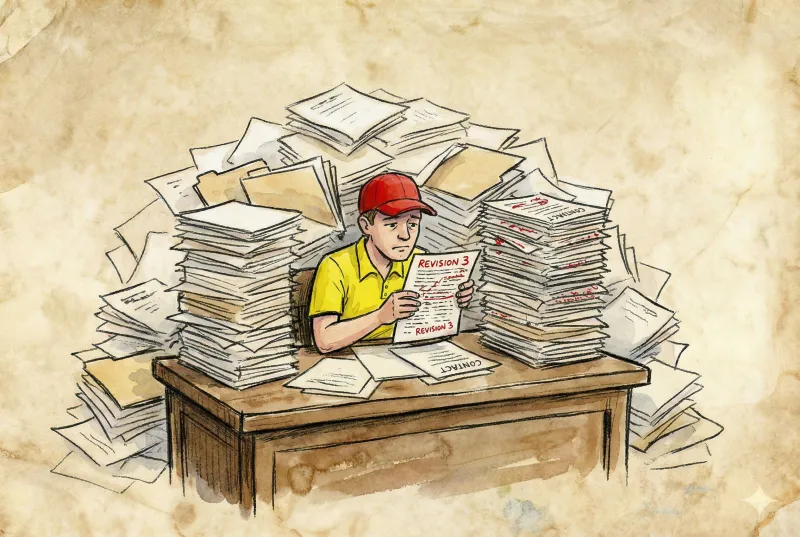
Pick your highest-volume deliverable. Blog posts, email campaigns, ad creative, whatever your team produces the most of. Now look at the last 20 of those that went out the door. How many times did each one get sent back for revisions before someone finally approved it?
If you're like most agencies I've seen, the answer is somewhere between 2 and 3 rounds. Some deliverables get touched four or five times before they're actually done.
Every one of those extra rounds is time your team spent doing work that was already supposed to be finished. A copywriter submits a draft. Gets notes. Revises. More notes. Revises again. The client sees it, catches something that should have been flagged internally. Another revision.
That piece of copy was "done" three separate times. Your client saw one deliverable.
When you add it up across your whole team, most agencies are losing 20 to 40 percent of their productive time to this invisible loop. I've seen it over and over. A 12-person team functioning like an 8-person team, and the founder can't figure out why hiring doesn't seem to help.
Where It Actually Comes From
The natural instinct is to blame people. The writer isn't detail-oriented enough. The designer doesn't read briefs. The PM dropped the ball.
Sometimes that's true. But in my experience, the root cause is almost always the system, not the people.
Handoffs without clear criteria. When does a task move from one person to the next? If the answer is "when they feel like it's ready," you've built revision loops right into your workflow. Every handoff that doesn't spell out what "done" means at that step is going to generate extra rounds.
No check before the client sees it. In most agencies, the first real review happens when the work hits the client's inbox. Internal review either doesn't exist, happens inconsistently, or comes too late to catch anything meaningful. Catching a problem at the client stage costs you ten times what catching it earlier would have.
Templates that drifted. You built solid templates six months ago. Since then, people have created workarounds, skipped fields, invented their own naming conventions. The template is still sitting in your project management tool. Nobody uses it the way it was designed anymore.
Monthly setup done by hand. Every month, someone manually rebuilds the same recurring projects. They miss a step. They forget to assign something. Two weeks later, a deliverable falls through the cracks. That's 15 to 20 hours of PM admin time per month, and it generates problems downstream every single time.
Manufacturing identified all of these failure modes decades ago. They have names for them. More importantly, they have proven fixes.
What the Fix Actually Looks Like
I'm not going to tell you to "implement better processes." That advice is about as useful as telling someone with a leaky roof to stop the water.
Here's what actually works, translated from 80 years of manufacturing wisdom into language that makes sense for your agency.
Every deliverable has a written definition of "done" before anyone starts working on it. Not a vague brief. A specific, checkable list of what this piece of work needs to include and look like before it moves to the next person. Your team stops guessing what "good" means because it's written down at every step.
There's a scored check at each step, not just at the end. Instead of you reviewing everything right before it goes to the client, the work gets checked as it moves through each stage. Scored. Tracked. Visible. You stop being the last line of defense because the defense is built into the workflow itself.
The work moving through the system IS the status update. Nobody fills in a status field. Nobody sends a Monday morning update. Where the work sits in the sequence tells you everything. You open a dashboard and see what's flowing, what's stalled, and where quality is slipping. Without asking anyone. Without a meeting.
Monthly buildout is automated. You build the recurring project templates once, build them right, and let the system create them every month. No missed steps. No forgotten assignments. No downstream fires from setup mistakes.
When I rebuilt the workflow at an email marketing agency using these principles, their revision rounds dropped roughly 75 percent. Output per person doubled. Not from hiring. Not from longer hours. From designing the system so work moved through the team without compounding errors at every stage.
The Math That Should Make You Uncomfortable
Let's put real numbers on this.
Say you have 12 people at an average fully loaded cost of ,000 a month each. That's ,000 a month in labor. If 30 percent of that productive time goes to doing work twice, you're spending ,600 every month on output that shouldn't need to happen.
That's ,200 a year. Not on growth. Not on new clients. On doing things twice.
At 25 percent it's ,000. At 40 percent it's ,600. Whatever your number is, I promise it's worse than you think. Because nobody measures this. It's invisible until you actually go count.
The fix is a fraction of that cost. A complete workflow rebuild, where you map how work actually moves, measure where it breaks, and reconfigure your tools around the real flow, typically takes 4 to 6 weeks and pays for itself within the first quarter.
Manufacturing calls this the "cost of poor quality." They've been calculating it and fixing it since before most of us were born. There's no reason your agency should keep paying a tax that was solved in 1950.
Start With This
You don't need to overhaul everything tomorrow. Just start measuring.
Pick your highest-volume deliverable type. Track every revision cycle for two weeks. When something gets sent back, write down why. Brief was unclear. Assets were missing at handoff. Feedback was subjective and should have been documented in a style guide. Scope changed mid-stream.
Then add up the hours your team spent on those extra rounds. Multiply by your blended hourly rate.
That number is your invisible tax. And once you see it, you can't unsee it.
The beautiful thing is that an entire discipline has already figured out how to shrink it. You don't need to invent anything new. You just need someone who speaks both languages... manufacturing rigor and agency reality... to translate it into your world.
I've spent 6 years building operational systems inside agencies, and the last few years specifically translating manufacturing principles into agency workflows. If you want to see what your invisible tax actually looks like, book a free 45-minute diagnostic and we'll map it together.
Frequently Asked Questions
Is some amount of revision normal? Absolutely. Creative work involves iteration and that's healthy. The goal here isn't zero revisions. It's eliminating the revisions caused by broken handoffs and missing information rather than genuine creative refinement. A revision because the client changed strategic direction is very different from a revision because nobody attached the brand guidelines.
What's a good target for revision cycles? Below 1.5 rounds per deliverable is strong. Between 1.5 and 2.0 is average. Above 2.5 means there are structural problems in the workflow. But honestly, the trend matters more than the absolute number. Are you improving month over month?
Does this work with Asana and ClickUp? The underlying problem is tool-agnostic. It's a workflow design issue. That said, the fix gets implemented inside your project management tool. Both Asana and ClickUp can support structured handoffs and tracked checks when they're configured correctly. Most implementations just weren't designed with these principles in mind.
We already have templates. Why do we still have revision loops? Templates solve the "what" question. What tasks need to happen. They don't solve the "how." How does work move between people? What's required at each handoff? What does "done" actually mean at each stage? Most template setups start strong and degrade within 3 to 6 months because they were designed around the tool's features instead of the team's actual workflow.
How is this different from other ClickUp or Asana consultants? Most implementation consultants do a one-time build. They set up your tool, hand you the keys, and move on. They don't run the monthly project buildout. They don't measure whether the system is actually reducing revision rounds. They don't redesign the workflow when it drifts. Remote Executive builds it and runs it. Every month. Because a system that isn't maintained is a system that stops working.
Can't we just hire a better project manager? A strong PM absolutely helps. But if the workflow itself generates extra rounds through unclear handoffs and missing checks, even a great PM spends their time fighting the system instead of managing the team. Fix the system first. Then let your PM actually manage.